Dolce Far Niente and the Lowndes Family
The following is excerpted from an article written by Missy Craver Izard in 2020. You can read her entire article here.
Many who live in Flat Rock pass by the stone columns along Greenville Highway, just southeast of St. John in the Wilderness Episcopal Church, several times a week. The tilting columns stand as reminders of a once-grand home called Dolce Far Niente, built ca. 1837 by Thomas Lowndes. That home, and the property surrounding it, would become a magnet drawing generations of Lowndes descendants back to Flat Rock for nearly 200 years. This is the story of the house, the land, and the family legacy they helped create. Many thanks to Missy for her contributions to Flat Rock Together and the history of our Village.
Since the early days of the colony that became known as “The Little Charleston of the Mountains,” the Lowndes family of Charleston was here. Of English descent, they were planters who made their fortunes in sugar and rice and public servants who contributed to their communities, state, and country. Rawlins Lowndes was the last "president” of South Carolina, serving in 1778. He only served one year, as the next year the title was changed to governor.
Their heritage includes significant historic Flat Rock properties, including “Diamond in the Desert,” once the rectory for St. John’s in the Wilderness Episcopal Church; “The Rock,” now called the Lowndes House and the home of the Flat Rock Playhouse; and “Dolce Far Niente,” the Lowndes family summer home and the origin for this story.
--
Dolce Far Niente
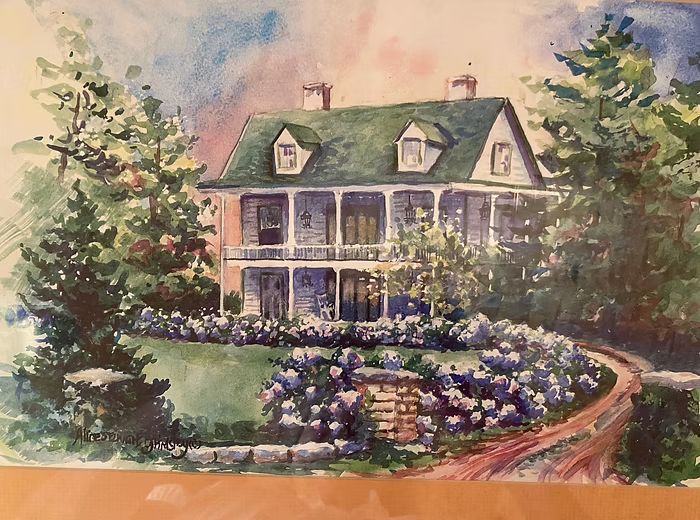
Thomas Lowndes, son of Rawlins Lowndes, bought 125 acres from Charles Baring in 1836 to build his Flat Rock summer residence, Dolce Far Niente (Italian for “Sweet Nothing to Do”), a large house with piazzas on each floor and “quaint Barbadian characteristics.” After living there two years, he sold the property to Anne Elliott.
In 1902, his great-grandson, Richard I’On Lowndes II, (I’On) and his wife, Inez Whitridge Bailey, bought the house and 22 acres back from the Elliotts, returning it to family ownership and living in it year-round.
In 1924, I’on Lowndes’s son, Richard I’On Lowndes III (“Punk”) built a small, one-and-a-half-story cottage with gable wings and wraparound porches on the property for his bride-to-be, Elizabeth Plumb. They never lived in the cottage.
Lowndes’ (Punk’s) sister, Alice Izard Middleton Lowndes and her husband, William Parker Andrews, Sr. (Wick), lived there with their two children, Elizabeth Middleton Andrews Lee (Betty) and William Parker Andrews, Jr. (Wick, Jr.), until 1939 when they built their own house on Lowndes Lane.
-
Stories of Growing up Flat Rock
Over time, Wick, Jr. became a legendary Flat Rock storyteller. He shares fond memories of Flat Rock and the Mayberry household in his Growing up Flat Rock recording. Some of those stories are shared here:
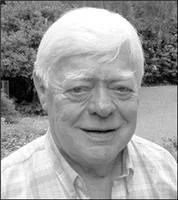
Wick Andrews, Jr.
“My best friend, Eddie Walker of Charleston, was the grandson of Mr. Mayberry and spent his summers in Flat Rock. His aunt was Emmy Mayberry McIntire, mother’s best friend. Emmy and my mother were champion tennis players, winning the Ladies Southern Tennis Title for doubles and my mother for singles in 1922. Eddie and I came by our tennis playing talents naturally.
The Mayberry house had a bat problem in the attic, so Eddie and I would shove sticks between the boards of the attic ceiling, irritating the bats. As the bats flew out, we sharpened our tennis skills with each one we hit. Word got out of our talents, and Robroy Farquhar, director of the Flat Rock Playhouse, hired us for five cents a bat to help with the problem during performances. One evening as the curtain rose and the lights went out, bats began circling the stage. We went to work with our bat magic, and everything was going well until we hit one that landed on the leading lady’s head. She screamed and ran off the stage, causing an uproar. It was the end of our batmen careers.”
“Another time, Eddie and I along with a few others, walked into Hendersonville for the weekly auction at the Skyland Hotel. We boys looked like a bunch of barefooted ragamuffins up there on the front row. The auctioneer held up a big bird cage and one of my friends, Burnet Maybank, bid 25 cents. The audience got real quiet when they saw we were bidding and no one else bid against us. Before we knew it, the auctioneer called ‘sold,’ and Burnett had won the bird cage. Between the six of us, we couldn’t come up with 25 cents. The auctioneer gave it to us anyway.”
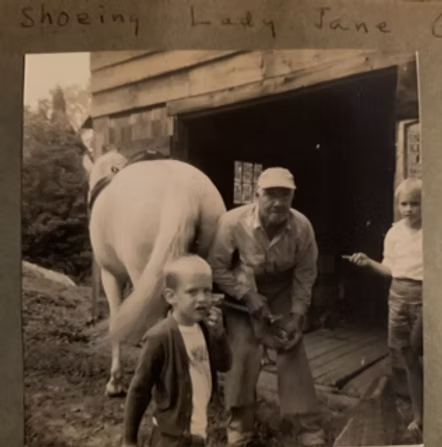
Jim Markley shoeing Lady Jane, a horse of Alice Andrews, whose grandchildren look on.
Photo Courtesy of Alice Lee
“Most mornings, we would make a sandwich and go explore. We would roam the hills, hang out at Markley’s Blacksmith shop or Peace’s Grocery store, and go for a swim at Highland Lake.
“Bonclarken, the Presbyterian Conference Center, had a big apple orchard and we could get in there by way of their lake to steal apples. One Sunday afternoon about eight of us decided we wanted some apples. We didn’t have our bathing suits, so we stripped out of our clothes and jumped in the lake. Old Mr. Ellis, the head of Bonclarken, had a keen eye and came running out yelling, ‘I’ll teach you boys to swim on the Sabbath.’ We jumped out of the water, grabbed our clothes, and ran as fast as we could down the road naked. I’m sure we were quite a sight.”
“In the winter, Highland Lake would freeze solid. The ice was thick. Granddaddy (I’ons Lowndes)would cut blocks of ice from the lake and wrap it in sawdust and put it in the ice house. This was their refrigeration. My cousin, Oscar Meyer, started the first airport in Hendersonville. When the lake would freeze, Oscar would land his plane right on Highland Lake and pull us across the ice by a rope attached to the plane. It was like playing crack the whip.”
According to The National Register of Historic Places:
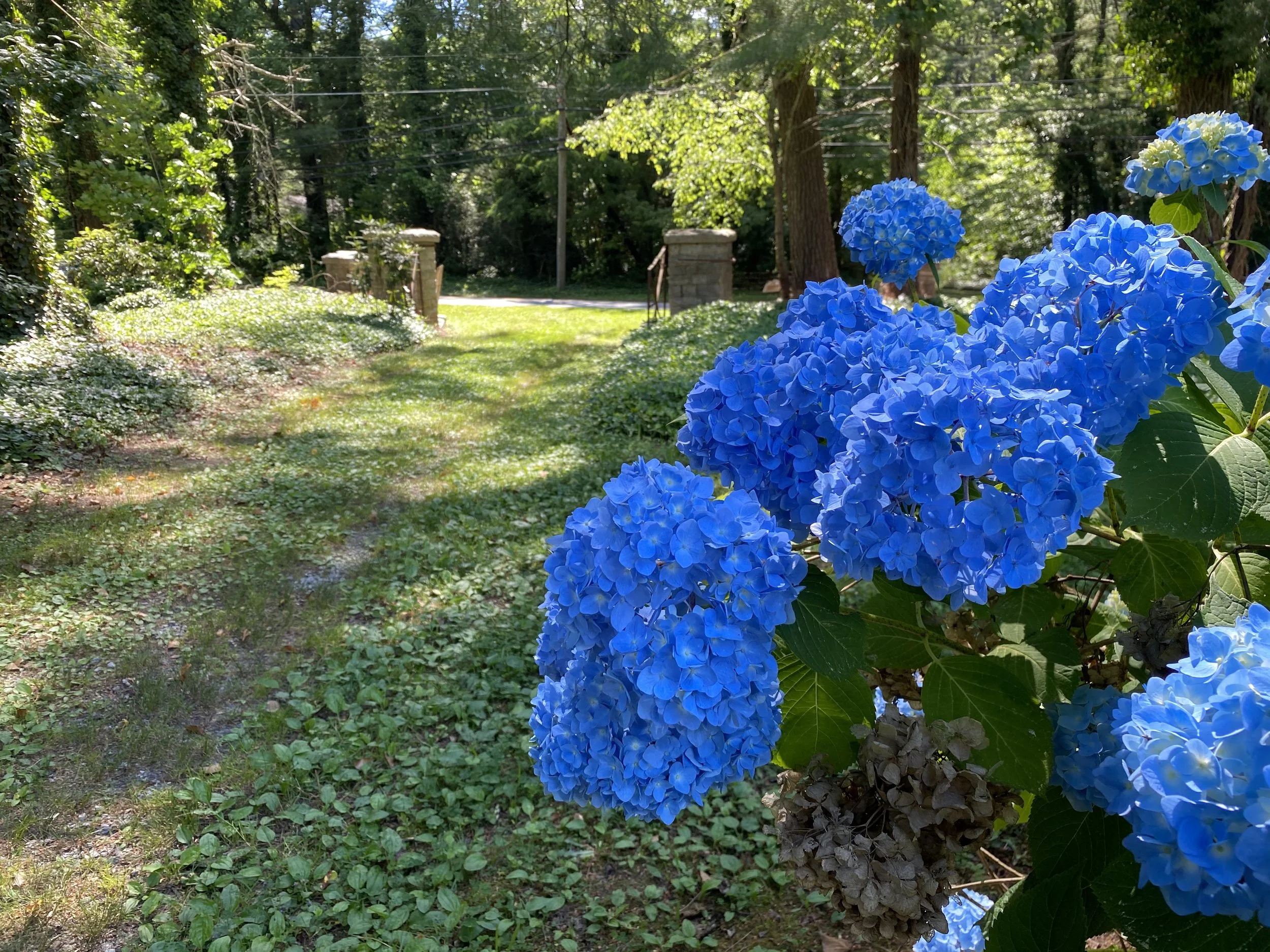
Hydrangeas still line the old driveway of Dolce Far Niente. The granite gate posts are visible in the background.
“In 1942, a few years after the death of I’On Lowndes’ wife, Inez, in an automobile accident, Lowndes and his five grown children sold the northern half of the Dolce Far Niente property, including the 1837 house and cottage to O.G. Lindsey. The family divided the remaining southern portion into five lots of about 1.5 acres each, one for each living child, with a common driveway, which is the present-day Lowndes Lane.”
By 1960, the historic house had deteriorated and was demolished. Lindsey then sold the property to Clemson professor Lawrence W. Baynard, whose descendants still own it. While the house no longer stands, original landscape features including a horseshoe driveway lined with hydrangeas and locally quarried granite block fence and gateposts still exist.
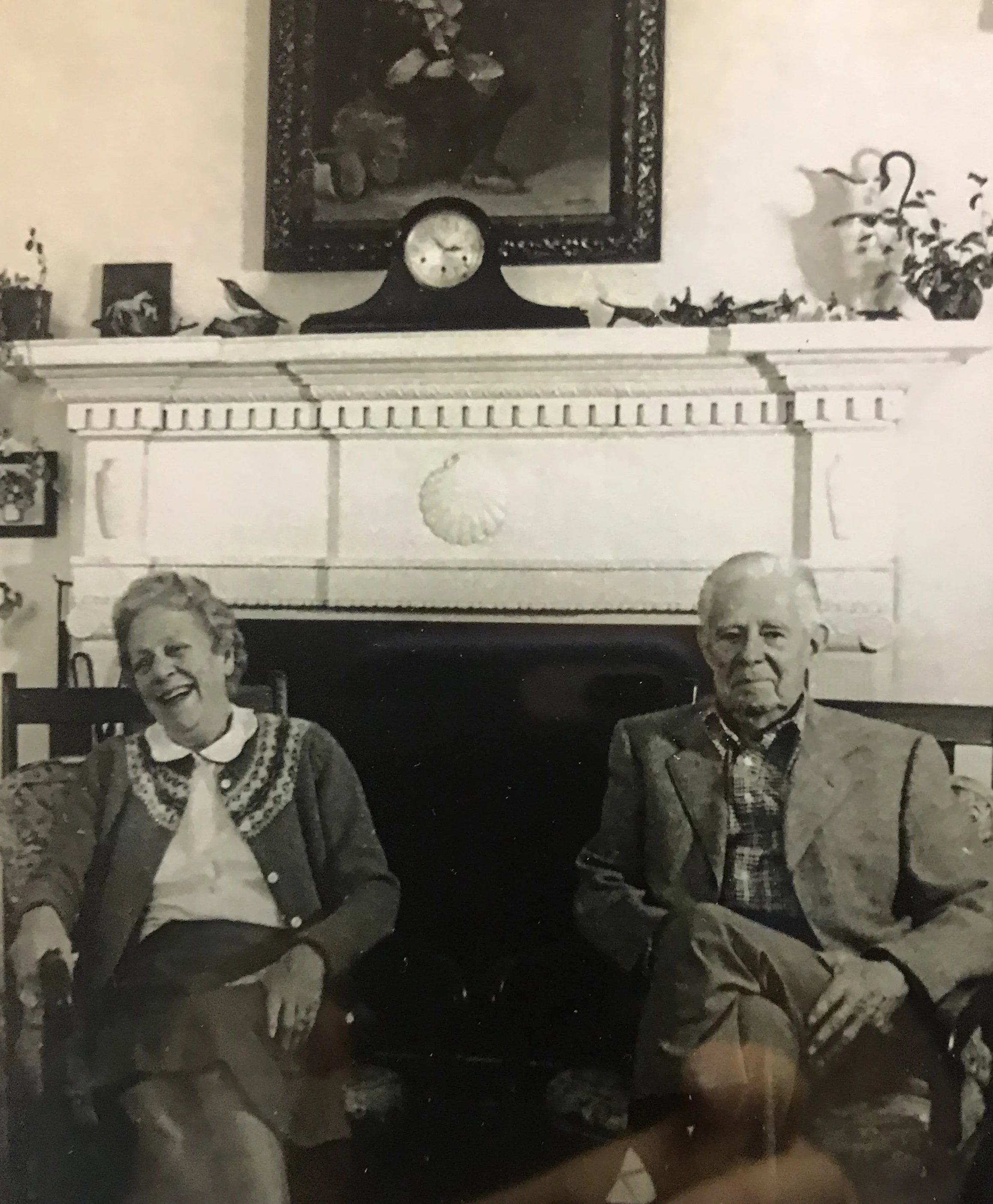
Alice and Wick Andrews, Sr.
Alice Lowndes Lee Fraser grew up visiting her grandparents, Alice and Wick Andrews, Sr., at their home, “Looking South,” on Lowndes Lane. Known for its south-facing orientation, the house is a one and a half story brick and weatherboard structure built in 1939 on a segment of the original Dolce Far Niente property before the 1942 division of the southern portion.
Alice’s Fraser’s grandparents, “Grandwick and Sweetums,” eventually bought a second lot adjacent to their property from her grandmother’s sister. Alice shared stories of her grandmother:
“On this (2nd) parcel, grandmama Alice, an accomplished horsewoman, built a small barn and riding ring where she taught generations of children to ride. One of my grandmother’s favorite tricks was to put a sugar lump between her teeth and let her horse take it from her.
“My grandmother served as Camp Greystone’s premier riding instructor for more than 25 years and was in charge of all aspects of the program, including renting the horses. Each summer she would recruit her grandchildren and their friends to ride the horses from Flat Rock down to Camp Greystone in Tuxedo. We would go through the McCabe’s property on Greenville Highway up to Pinnacle Mountain and down through the apple orchard in Zirconia.
“We always passed this old, ramshackle house with mud dauber nests all over it. On the porch was a scary-looking mountain man with a beard down to his waist.
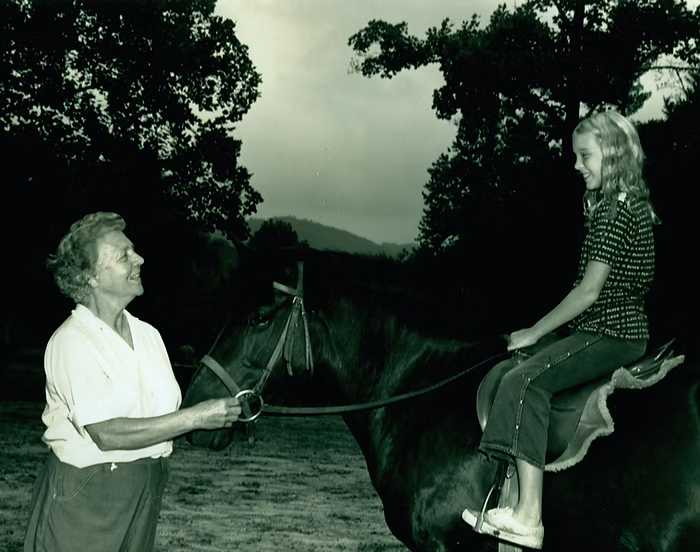
Alice Andrews, Camp Greystone riding instructor.
“My grandmother was a founding member of the Ladies Aid Society at St. John’s and made food baskets for families up on Pinnacle Mountain Road. One day, I went with her to deliver a basket to this man, and my grandmother parked her car right in front of the house, blocking his spitting range. It was the first time I learned about chewing tobacco.”
Jimboy Miller, Director of Camp Greystone, shared excerpts from the camp’s 100th anniversary book. “At Greystone, Alice Andrews was legendary. She quickly earned the name of “Mrs. A” and was beloved by all the campers and staff.” Edith Hanna Holt described Alice as “the epitome of the gracious, warm, Southern lady. The overnight riding trips she led when I was a camper were among the most fun things I have done in my life.”
“Alice Andrews was the soul of Flat Rock,” says Marty Whaley Cornwell. “My mother, Emily Whaley, said she had ‘Bunk of Locale.’ She traversed these mountain roads all of her life and never got lost. You trusted her sense of direction and respected her confidence. She was the leader of the pack; full of adventure, spunk, and compassion. The church parking lot (St. John in the Wilderness) was the central meeting place for Alice’s outings, and from there the group would head off to Pinnacle or Glassy Mountain, Sliding Rock, the Green River or on various horseback riding jaunts and hikes. When we came to Flat Rock for the summertime, we were expected to participate in these mountain adventures. It was part of our daily rituals.”
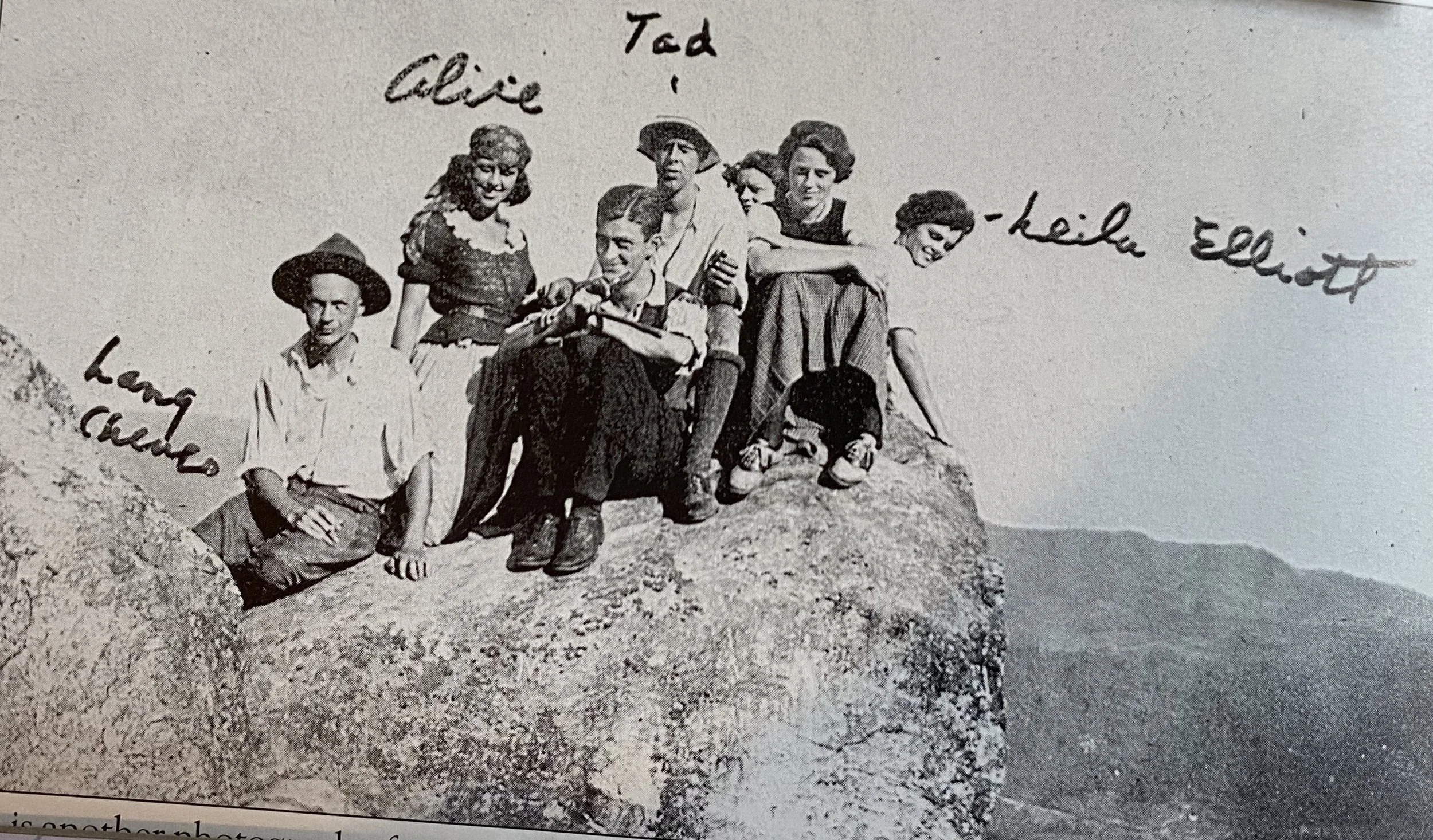
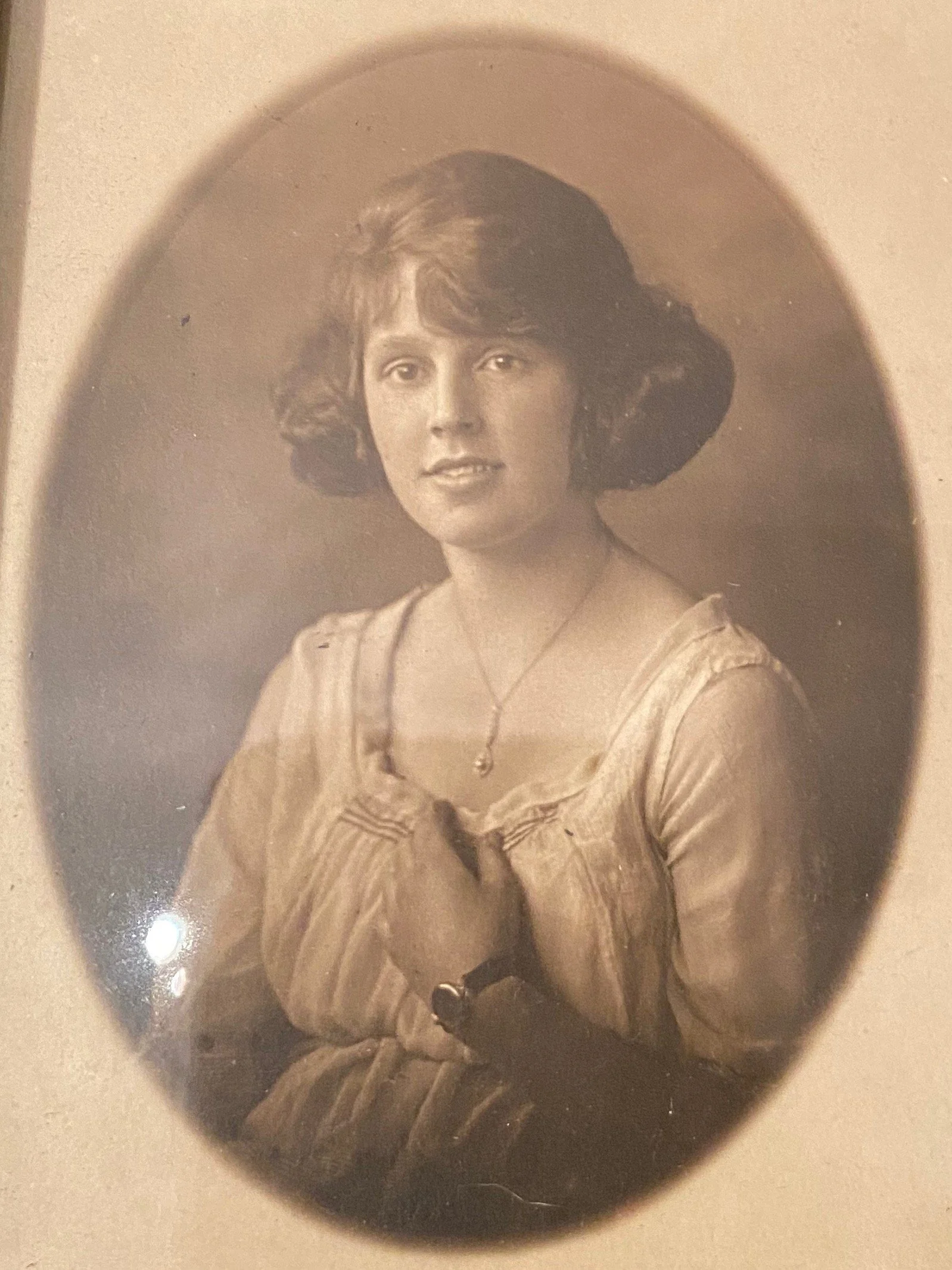
Alice Andrews (2nd from Left) as a young woman
On Sundays, Alice Andrews would put a note in the alms basket at church to let people know the location of the afternoon picnic. They liked to go to the Upper Green River, or below Pot Shoals, and to High Falls. She would leave church early to start frying the chicken. “We lived in Flat Rock year-round, and our house had the only telephone in the village. Everyone from Charleston would use it,” Wick, Jr. recalled. “My mother had a note by the phone that said, ‘When you come in to use the telephone, please turn the chicken.’ We had the best fried chicken in town!”
—-
From early June until Labor Day, the legacy of Dolce Far Niente symbolizes the steadfastness of the generations who have lived on this land. It is a portal to Lowndes family history, weaving recollections of idyllic summertime experiences into a pattern of its own and of the ties that have bound family and friends together for almost 200 years.
Missy Craver Izard was born and raised in Charleston, South Carolina, and now resides in Flat Rock, North Carolina. A retired summer camp director and art teacher, she is an entrepreneur, speaker, author, journalist, and community leader. Missy has received numerous honors for her work, including recognition as a White House Champion of Change.