Cereset: Restoring Balance from the Inside Out

Hunter Foster Pope
For Hunter Foster Pope, a Spartanburg native, the idea of balance and renewal is more than theoretical — it’s deeply personal. Hunter grew up spending summers on Lake Summit, her mother’s happy place, where life was quiet, simple, and truly the best. So when she found herself at a life-changing crossroads a few years ago, the family made an easy choice between Spartanburg and the lake: they moved to Lake Summit full-time.
For Hunter, both personally and professionally, the move has been about restoration — rediscovering peace and purpose in a place that already felt like home. “It’s definitely come with challenges — including Hurricane Helene last year,” Hunter said.
After graduating from Clemson University with a degree in Administrative Management, Hunter earned her MBA from the Wake Forest University Babcock Graduate School of Management. Marriage and a move to Sumter, S.C., led her into healthcare management, a path that would shape the next several decades of her career.
In 1996, Hunter returned to her hometown of Spartanburg and began a twenty-year tenure with Spartanburg Regional Healthcare System (SRHS). “When Renee Romberger interviewed me at Spartanburg Regional, she said, ‘Hunter, this job is your soul.’ I knew right away I wanted to work with someone like that — someone who exuded enthusiasm for helping people. We made a good team.”
During her time at SRHS, the hospital’s first Mind Body Spirit department was created, and Hunter was asked to lead it. The program grew out of a need for integrative healing options for cancer patients, with strong support from oncology physicians. Her work included collaborating with the M.D. Anderson Physicians Network in Texas and undergoing training with James Gordon of the Center for Mind Body Medicine. The goal was to offer an eight-week Mind-Body Skills Group for cancer survivors struggling with chemo brain, sleep disruption, mood changes, and the anxieties that accompany cancer. But many patients found it difficult to relax enough to fully benefit from the techniques.
Around this time, a Spartanburg physician approached Hunter about a Wake Forest study involving HIRREM — High-Resolution, Relational, Resonance-Based Electroencephalic Mirroring, the scientific foundation behind what is now known as Cereset. He encouraged her to explore its potential for SRHS. Wake Forest’s research became a key component of the Brain Body Research Program at the university’s School of Medicine, where much of the scientific evaluation of this approach has taken place.
After studying the Wake Forest program and Cereset, it became clear this technology could help jumpstart healing for cancer survivors. A grant was written to fund an initial program with ten women. It was a tremendous success.
“It’s rewarding to work with all Cereset clients, but this focus on cancer survivors helped me appreciate even more deeply the power of enabling the brain to optimize itself,” Hunter said. “It’s mind-body-spirit healing at its best. Seeing Cereset bring such relief to these brave women who battled and survived the ripple effects of trauma and treatment gives a profound sense of hope.”
Another public affirmation of Cereset’s impact came when singer Amy Grant shared the dramatic improvement it brought to her niece. Grant later completed training herself to help others — especially veterans struggling with PTSD.
For nearly a decade, the Mind Body Spirit department at Spartanburg Regional flourished. But as out-of-pocket healthcare costs rose and insurance coverage for integrative services declined, sustaining the program became increasingly difficult. When the hospital decided to close its Cereset division, Hunter made a bold decision: she purchased the Cereset franchise for Spartanburg and launched her own practice in 2020.
Cereset Moves to Flat Rock
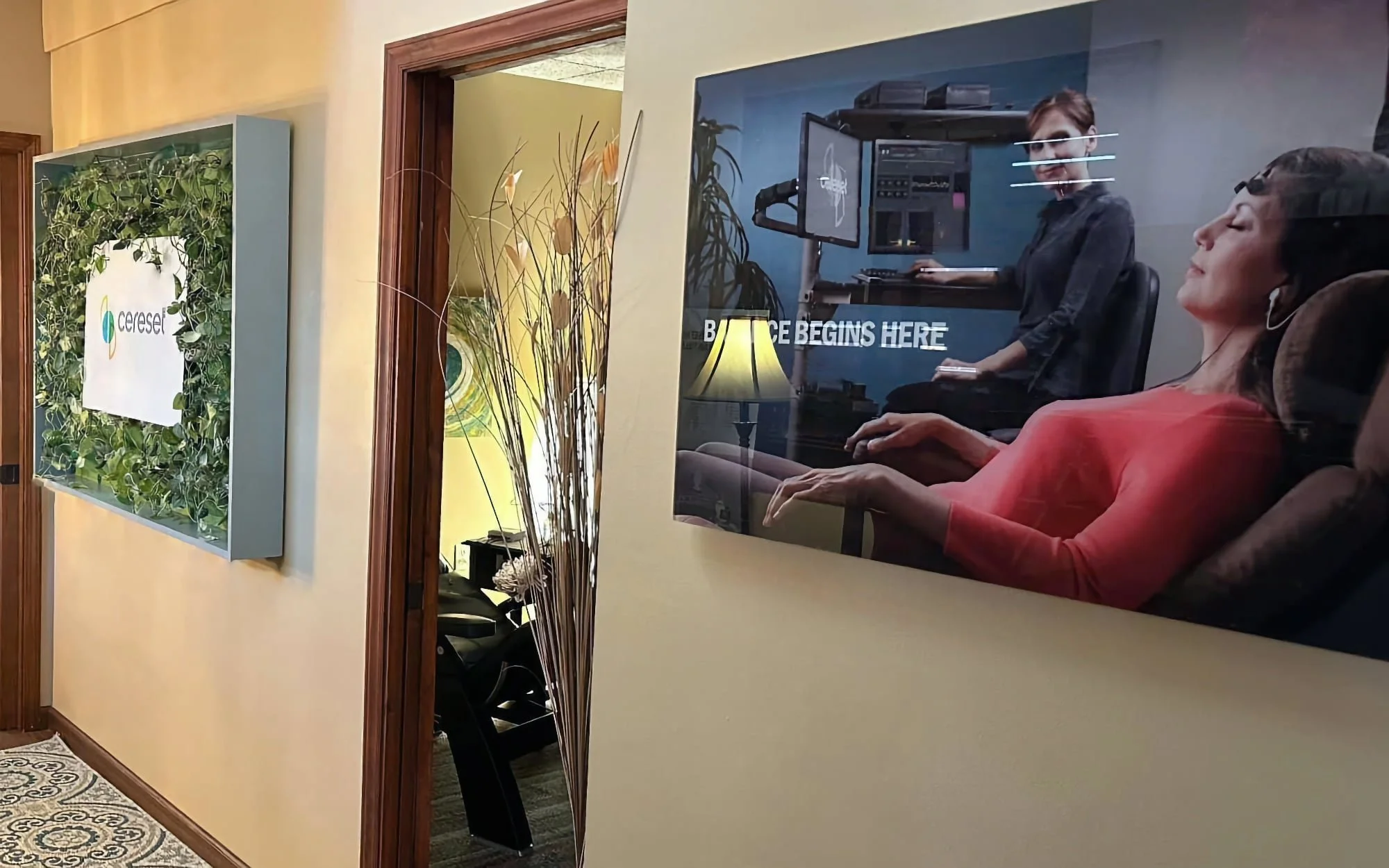
Cereset Lobby in Flat Rock
The transition to Lake Summit also meant relocating Hunter’s business. Now situated in the rear of Salon Christianne in Flat Rock Square, Cereset continues its mission of helping clients find calm, clarity, and balance through advanced brain technology. The name captures the essence of the work: Cere (cerebrum) + reset — returning the brain to a more optimal state.
“Taking care of ourselves should be a priority for everyone, yet it’s often something we promise we’ll do ‘later,’” Hunter said. “We know how to eat better or exercise more, but we rarely consider caring for our brain — the hub of the wheel of life. If the brain is the hub, the nervous system forms the spokes, and the body the rim. When the hub is out of balance, the whole wheel wobbles.”
Lee Gerdes, founder of Cereset, echoes this idea: “If you’ve ever driven an automobile with one or more tires out of balance, you know the shimmy and shake that an out-of-balance condition can produce. In this condition, it simply isn’t possible to live a life of excellence.”
A balanced brain promotes clarity, creativity, emotional steadiness, and a sense of alignment with one’s life path. When the brain is out of sync, individuals may feel stuck, overwhelmed, or unable to show up as their fullest selves.
That’s where Cereset comes in — a noninvasive, natural way to support the brain in restoring its own harmony.
The Founder’s Story: From Trauma to Innovation
When Lee Gerdes founded Scottsdale-based Cereset and developed the technology that uses brain-initiated sound to help balance the brain, it wasn’t because he wanted to — it was because he had to.
At age 45, Gerdes was attacked in San Francisco by a group of young men wielding a baseball bat. The assault left him with a mild traumatic brain injury and eight years of worsening post-traumatic stress.
“The symptoms became worse and worse,” Gerdes said. “And every time I tried something new, I got worse, not better.” Neurofeedback didn’t help. Shamanism didn’t help. Self-medication didn’t help. What followed were years of high stress, paranoia, sleepless nights, and despair.
Drawing on his background in mathematics, physics, computer software development, theology, and psychology, Gerdes set out to develop a new approach.
Using EEG recordings, he began tracking the balance between his left and right hemispheres. “When I was feeling really bad, they were highly asymmetrical,” he said. Typically, left-dominance correlates with the numb “freeze” response, while right-dominance correlates with the heightened anxiety of fight-or-flight. When he felt better, his brain was less asymmetrical.
After dozens of self-tests came a breakthrough: What if the brain wasn’t meant to be asymmetrical? And could it be gently guided back toward symmetry?
“That’s what I set out to do,” he said.
(Excerpt adapted from Kristine Cannon, Scottsdale Progress, 2019.)
Hunter’s Story

“For me, Cereset has been a lifesaver,” Hunter shared. “My older brother died when I was 19. He had just graduated from college and been accepted to medical school. We were very close, and his death was devastating. The trauma and grief were shelved for years. Cereset helped me uncover how deeply that loss affected me. I can’t say enough about how much this technology helped reset my brain and restore harmony to my life.”
“Cereset helps your brain relax and reset itself,” Hunter explained. “Our brains’ left and right hemispheres constantly communicate. Stress, illness, grief, or trauma can disrupt that communication and create imbalance. Overwhelming stress can numb us — the ‘freeze’ response. It can also activate fight-or-flight. Either way, the brain becomes stuck.”
The Cereset Process
So how does Cereset help the brain return to balance?
Sensors placed on the client’s scalp translate brain activity into musical tones heard through earbuds. As the client relaxes — often drifting into deep sleep — the brain listens to itself in real time. This closed-loop feedback begins allowing the brain to reorganize, forming new neural pathways that support healthier, more balanced function. This natural adaptive process is known as neuroplasticity.
A typical Cereset Research experience begins with a five-session series, including an assessment of brain patterns and a customized plan designed to relax, rebalance, and reset the brain for improved acuity, sleep, mood, and energy. Each session lasts about an hour. The brain guides its own adjustments; the client simply relaxes.
“The fact that this technology is non-invasive, non-pharmacological, and does not require recipients to ‘do anything’ other than allow the brain to repair itself is very exciting,” said Dr. Charles Tegeler, neurologist at the Wake Forest School of Medicine.
Conclusion
Cereset is shaping a new way of thinking about well-being — one that trusts the brain’s remarkable ability to restore itself. Here in our community, it offers an accessible, noninvasive path for anyone seeking more calm, better sleep, clearer thinking, or simply a return to feeling like themselves again.
Grounded in science yet rooted in deeply personal stories of transformation, Cereset reflects a simple but profound truth: when the brain finds balance, the whole person begins to thrive. For many, that balance isn’t just life-improving — it’s life-changing.
—
For more information:
Hunter F. Pope – Cereset Coach
2686 B Greenville Hwy.
Flat Rock, NC 28731
828-348-1144
hunter@flatrock.cereset.com